Output Message When You Click a Button Delete When Pressed Again
The World Engine (EE) Code Editor at code.earthengine.google.com is a web-based IDE for the Earth Engine JavaScript API. Code Editor features are designed to make developing circuitous geospatial workflows fast and like shooting fish in a barrel. The Lawmaking Editor has the following elements (illustrated in Effigy 1):
- JavaScript code editor
- Map display for visualizing geospatial datasets
- API reference documentation (Docs tab)
- Git-based Script Managing director (Scripts tab)
- Console output (Console tab)
- Task Manager (Tasks tab) to handle long-running queries
- Interactive map query (Inspector tab)
- Search of the data annal or saved scripts
- Geometry drawing tools
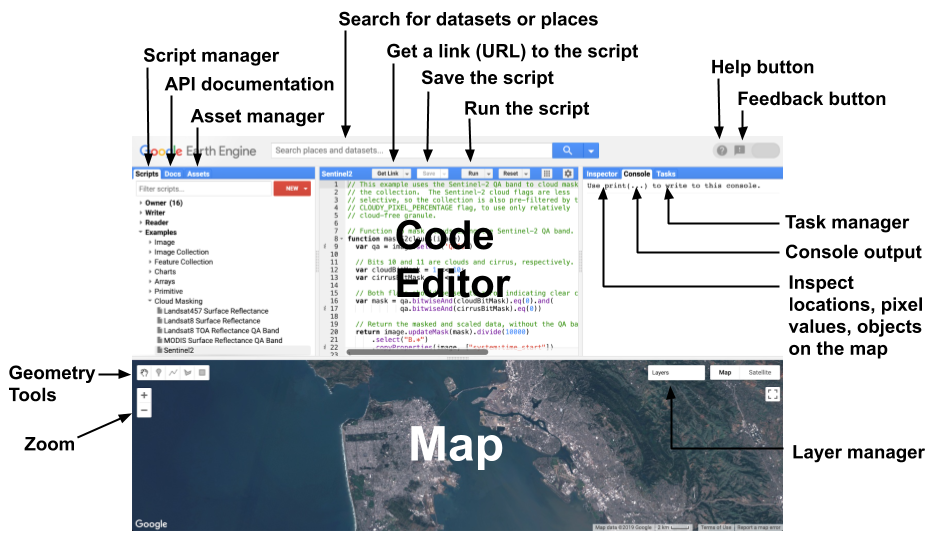
The Code Editor has a variety of features to aid you take advantage of the Globe Engine API. View example scripts or save your own scripts on the Scripts tab. Query objects placed on the map with the Inspector tab. Display and chart numeric results using the Google Visualization API. Share a unique URL to your script with collaborators and friends with the Go Link button. Scripts you develop in the Code Editor are sent to Google for processing and the generated map tiles and/or letters are sent back for brandish in the Map and/or Console tab. All you need to run the Code Editor is a spider web browser (use Google Chrome for best results) and an internet connection. The following sections describe elements of the Earth Engine Code Editor in more than detail.
JavaScript editor
The JavaScript editor will:
- Format and highlight lawmaking as you type
- Underline code with problems, offer fixes and other hints for correct syntax
- Autocomplete pairs of quotes, brackets and parentheses
- Offer code completion hints for Earth Engine functions
Above the code editor are buttons for running the script, saving the script, resetting the output map and console, and getting a link to the script. When the Get Link button is pressed, a unique link will appear in the browser'south address bar. This link represents the code in the editor at the time the button was pressed.
API reference (Docs tab)
On the left side of the Code Editor is the Docs tab, which contains the consummate JavaScript API documentation. The documentation can be searched and browsed from the Docs tab.
Script Manager (Scripts tab)
The Scripts tab is adjacent to the API Docs in the left panel of the Code Editor. The Script Manager stores private, shared and instance scripts in Git repositories hosted past Google. The repositories are arranged by access level, with your individual scripts stored in a repository you own in the Possessor folder: users/username/default. You (and only y'all) take access to the repositories in the Owner folder unless you share them with someone else. The repositories in the Writer binder are repositories for which write admission has been granted to yous past their owner. Y'all can add new scripts to, modify existing scripts in, or change access to (you may not remove their owner) the repositories in the Author binder. The repositories in the Reader folder are repositories for which read access has been granted to yous by their owner. The Examples binder is a special repository managed past Google which contains code samples. The Archive folder contains legacy repositories to which y'all accept access simply have not notwithstanding been migrated past their owner from an older version of the Script Managing director. Search through your scripts using the filter bar at the top of the Scripts tab.
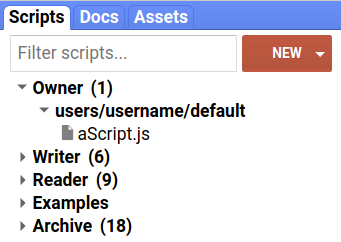
Click the  button to create a new repository in the Owner folder or to create folders and files inside a repository. You lot tin can rename scripts with the icon and delete them with the icon. You can move scripts and organize them into folders using drag and driblet (Figure 2). If yous drag a script to another repository, it gets copied.
All scripts and repositories maintain full version history. Click on the icon next to a script or repository to compare or revert it to an older version. To delete a repository, click the icon. To configure access to a repository, click the icon next to the repository name. Notation that if you lot share a repository, the person with whom you lot're sharing will demand to have the repository past clicking the link shown in the settings dialog. Previously accustomed repositories tin can be hidden by clicking the icon following the repo proper noun in the Script Manager.
Repositories can exist accessed using Git, so yous can manage and edit your scripts outside the Code Editor, or sync them with an external system like GitHub. (Learn more most Git from this tutorial). Click on the icon next to the repository proper noun for instructions on cloning the repository. Note that y'all can browse the repositories to which you take access by going to earthengine.googlesource.com. For some Git operations, yous may need to create authentication credentials by going to the Generate Countersign link at the tiptop of the earthengine.googlesource.com page.
Script modules
Information technology's good practice to write modular, reusable code that can be shared betwixt scripts without extensive copying and pasting. To enable modular development, Earth Engine provides the ability to share code betwixt scripts. For example, suppose you write a office that performs a useful set of operations. Rather than copy the code of the function into a new script, it's easier for the new script to load the office directly. To make a part or object available to other scripts, you add it to a special object called exports. To use the lawmaking in another script, apply the require function to load the exports from another script. For example, suppose yous define the following module in a file named FooModule.js which is in a folder named Modules:
Lawmaking Editor (JavaScript)
/** * The Foo module is a sit-in of script modules. * It contains a foo function that returns a greeting string. * Information technology likewise contains a bar object representing the current date. * @module Modules/FooModule */ /** * Returns a greeting cord. * @param {ee.String} arg The proper name to which the greeting should be addressed * @return {ee.String} The complete greeting. */ exports.foo = function(arg) { render 'Hello, ' + arg + '! And a good twenty-four hours to yous!'; }; /** * An ee.Engagement object containing the time at which the object was created. */ exports.bar = ee.Date(Date.now()); Notation the apply of the exports keyword in the course of exports.objectToExport. Yous can make use of this module in another script by using the require function. For example:
Lawmaking Editor (JavaScript)
var Foo = require('users/username/default:Modules/FooModule.js'); print(Foo.physician); print(Foo.foo('world')); print('Time now:', Foo.bar); The require function expects a string that describes the absolute path to the location of the module. Specifically, the argument of require() is of the form 'pathToRepository:pathToModuleScript'. Y'all can only load modules from repositories that you own and/or accept read access to. If you want others to be able to employ your module, the repository must exist shared with the other users y'all want to have access. You may wish to document your module to aid others understand how to utilise information technology; we recommend using JSDoc fashion with the @module tag.
You can apply the URL parameter ?scriptPath={repo}:{script} to share a reference to a file in your repo, e.thou. https://code.earthengine.google.com/?scriptPath=users/username/utils:utils. Upon visiting the URL, the referenced file and its repo volition be added to either the Reader or Writer directory on the Scripts tab, depending on your permission level for the shared repo.
Nugget Manager (Assets tab)
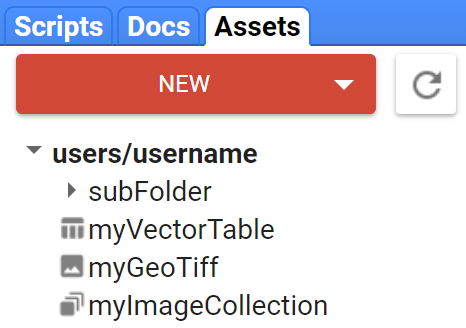
The Asset Manager is in the Avails tab in the left panel. Utilise the Asset Director (Figure 3) to upload and manage your own image assets in Earth Engine. See the Asset Manager page for details.
Script links
Code Editor scripts can exist shared via an encoded URL. The post-obit sections describe diverse ways to generate a script URL, bachelor options, and methods for managing script URLs.
Get link
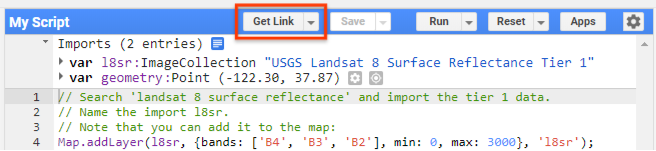
The "Get Link" button at the peak of the Code Editor (Effigy four) provides an interface for generating script URLs and setting script behavior options. Notation the distinctions between snapshot and saved script URLs described below.
Snapshot script links
Lawmaking in the Editor tin exist shared via an encoded snapshot URL that gets created upon clicking the "Get Link" push button at the top of the Code Editor. When the URL is visited by someone with an Globe Engine business relationship, the browser will navigate to the Code Editor and replicate the surroundings as it was when the link was created, including code, imports, map layers, and map position. Clicking the "Get Link" button will automatically copy the script link to the clipboard. Additionally, a dialog box will announced providing options to control the execution of the shared script, forth with buttons to re-create and visit the generated link. The control options include preventing the script from automatically running, and hiding the code pane when someone opens the shared link. The draggable dialog box tin can be dismissed via the "Esc" key or a click elsewhere on the page.
Saved script links
Saved scripts have an option to share a link that will ever load the most recent saved version and is just accessible by you and others with electric current access to the repository containing the script. To use this feature, load a saved script from the Script Manager tab, click the dropdown pointer to the right of the "Go Link" button and select "Copy Script Path". A dialog box will announced presenting the shareable script URL. Note that the script URL has also been set in the browser's address bar. For guidance on sharing your repository with others, please see the Script Manager section.
Script link management
The dropdown button to the right of the "Get Link" button has an selection to "Manage Links". Clicking this option loads a new browser tab with an interface for you to recall, remove, and download previously generated script links. Selecting a script and pressing the download button will download a zipped folder ("code_editor_links.naught") to your organization containing a .txt file representation for each selected script.
Script link URL parameters
The ui.url module allows programmatic manipulation of the script URL's fragment identifier via get and gear up methods. This means that Code Editor scripts and Earth Engine Apps can read and store values in the folio'southward URL. Notice the end of the following 2 URLs, the outset sets the debug variable as false and the second sets it as truthful; visit both links and notice that the debug checkbox in the panel is not checked in the kickoff, and is checked in the second, changing the behavior of each script.
https://code.earthengine.google.com/5695887aad76979388a723a85339fbf2#debug=fake;
https://code.earthengine.google.com/5695887aad76979388a723a85339fbf2#debug=true;
This feature can be used to set map zoom and center, also as other behaviors y'all might want to customize when sending links to particular people or groups.
To find datasets to use in your scripts, you can use the search tool for the data archive. The search tool is the text box at the height of the Lawmaking Editor that says 'Search places and datasets...' Blazon the name of a information production, sensor, or other keyword into the search bar and click the button to meet a list of matching places, raster and tabular array datasets. Click on any raster or table effect to see the description for that dataset in the archive. To import the dataset directly into your script, click the import link or the  button from the dataset description.
Imports
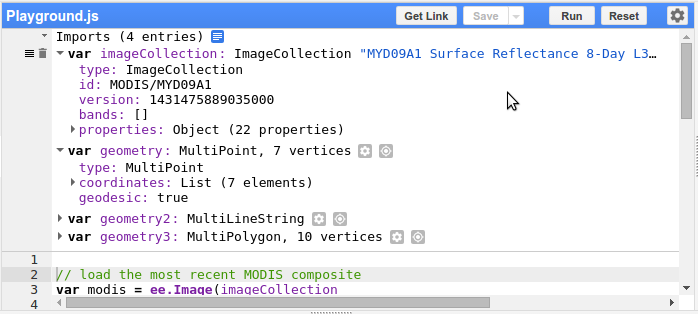
The results of importing datasets to your script are organized in an imports section at the top of your script, hidden until you import something. Once yous have created some imports, you should see something similar to Figure 5. To copy imports to another script, or catechumen the imports to JavaScript, click the icon next to the Imports header and copy the generated code into your script. Yous can delete the import with the icon.
Map
The Map object in the API refers to the map display in the Lawmaking Editor. For example, Map.getBounds() volition return the geographic region visible in the Code Editor. Check the Map functions in the API to see other customizations for this brandish.
Layer Manager
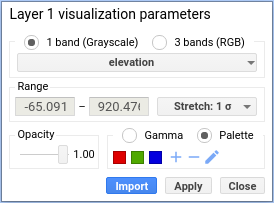
Utilise the Layer Director in the upper right corner of the map to adjust the display of layers you added to the map. Specifically, you can toggle the visibility of a layer or adjust its transparency with the slider. Click the icon to adjust visualization parameters for private layers. The visualization tool that appears (Effigy 6) allows you to interactively configure layer brandish parameters. Click the button on the right of the tool (which performs a Custom stretch to the supplied min and max range by default) to linearly stretch the brandish to either percentiles or standard deviations of paradigm values in the display window. Statistics are computed from all the pixels in the Map window at the current zoom level. Employ the sliders to suit gamma and/or transparency. Click the Palette radio push button and specify a custom palette by calculation colors (), removing colors () or manually entering a comma separated list of hex strings (). Click Use to apply the visualization parameters to the current display. Click Import to load a visualization parameters object as a new variable in the imports section of your script.
Notation that to the right of the Layer Manager are toggle buttons for unlike map backgrounds. Customize the background using Map.setStyle().
Inspector tab
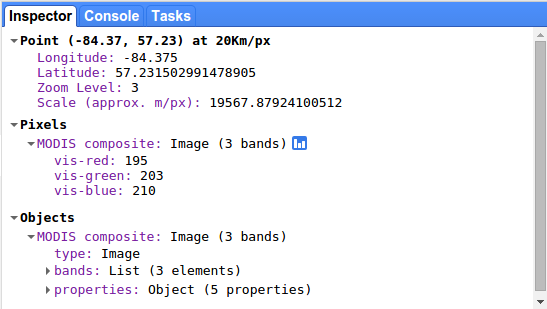
The Inspector tab adjacent to the Chore Manager lets you lot interactively query the map. When the Inspector tab is activated, the cursor becomes a crosshair which will display the location and layer values under the cursor when yous click on the map. For case, Figure 7 shows the results of clicking on the map with in the Inspector tab. The cursor location and zoom level are displayed along with pixel values and a list of objects on the map. The objects list is interactive. To see more information, expand the objects in the Inspector tab.
Console Tab
When you print() something from your script, such as text, objects or charts, the outcome will exist displayed in the Console. The console is interactive, so yous can aggrandize printed objects to get more details virtually them.
Tasks tab
Earth Engine Tasks are operations that are capable of running much longer than the standard API request timeout. These long-running tasks are the only mechanism for creating persistent artifacts in Earth Engine and adjacent systems (Google Cloud Storage, Google Drive, etc.), and they fall into two categories: Import and Export.
Import tasks can be used to upload images or upload tables into Earth Engine from a diverseness of filetypes (.csv, .tif, etc.). Export tasks can exist used to execute and write results from the EE ciphering organization (encounter the guide for exporting data ).
For exports, each call to an Export function in the Lawmaking Editor will populate an entry in the Unsubmitted tasks department of the Tasks tab. To submit an export task to the server, click the Run button next to the task. A configuration dialog will appear that allows you to specify a variety of parameters for the chore. If the task is fully specified at creation fourth dimension (that is, the call to Consign has all necessary parameters), hold ctrl or ⌘ while clicking Run to submit the task without showing the dialog.
For imports, file upload happens locally earlier the chore is submitted to the server. Import tasks in the upload phase will testify their progress in the Unsubmitted tasks department and automatically submit to the server once the file upload is complete.
Unsubmitted tasks only announced on the folio which created them, and they are lost when the page is closed. Once a chore is submitted to the server, clicking on its row in the UI will provide additional information and options about the task status, including the option to asking cancellation.
To view, search and cancel many tasks in a full-page view (including on mobile clients), use the Task Manager.
Profiler
The profiler displays data nigh the resources (CPU fourth dimension, memory) consumed by specific algorithms and other parts of a ciphering. This helps to diagnose why a script is running slowly or failing due to retentiveness limits. To use the profiler, click the Run with profiler option in the dropdown on the Run button. Equally a shortcut, concord downward Alt (or Choice on Mac) and click Run, or press Ctrl+Alt+Enter. This activates a Profiler tab on the right side of the code editor. As the script runs, the Profiler tab will display a table of resources usage from the script. Clicking the Run button (without profiling) will make the Profiler tab disappear and disable the profiler.
The profiler displays information about CPU and memory usage (per algorithm and asset) resulting from computations invoked past the script and the brandish of every tile currently visible in the map. Each row in the profiler output corresponds to an algorithm, computation, asset load or overhead operation as described in the 'Description' cavalcade. The columns in the profiler are:
- Clarification
- A textual description of the computation, algorithm, asset load or overhead operation existence profiled.
- Count
- An indicator proportional to the number of times the functioning described in 'Description' was invoked.
- Compute
- An indicator of CPU time taken by the operation(s).
- Current Mem
- This cavalcade appears only if there was an error because the script used likewise much memory. Information technology shows the amount of memory in utilize on any unmarried compute node at the moment the error occurred.
- Peak Mem
- Maximum retentivity used on any single compute node for the performance.
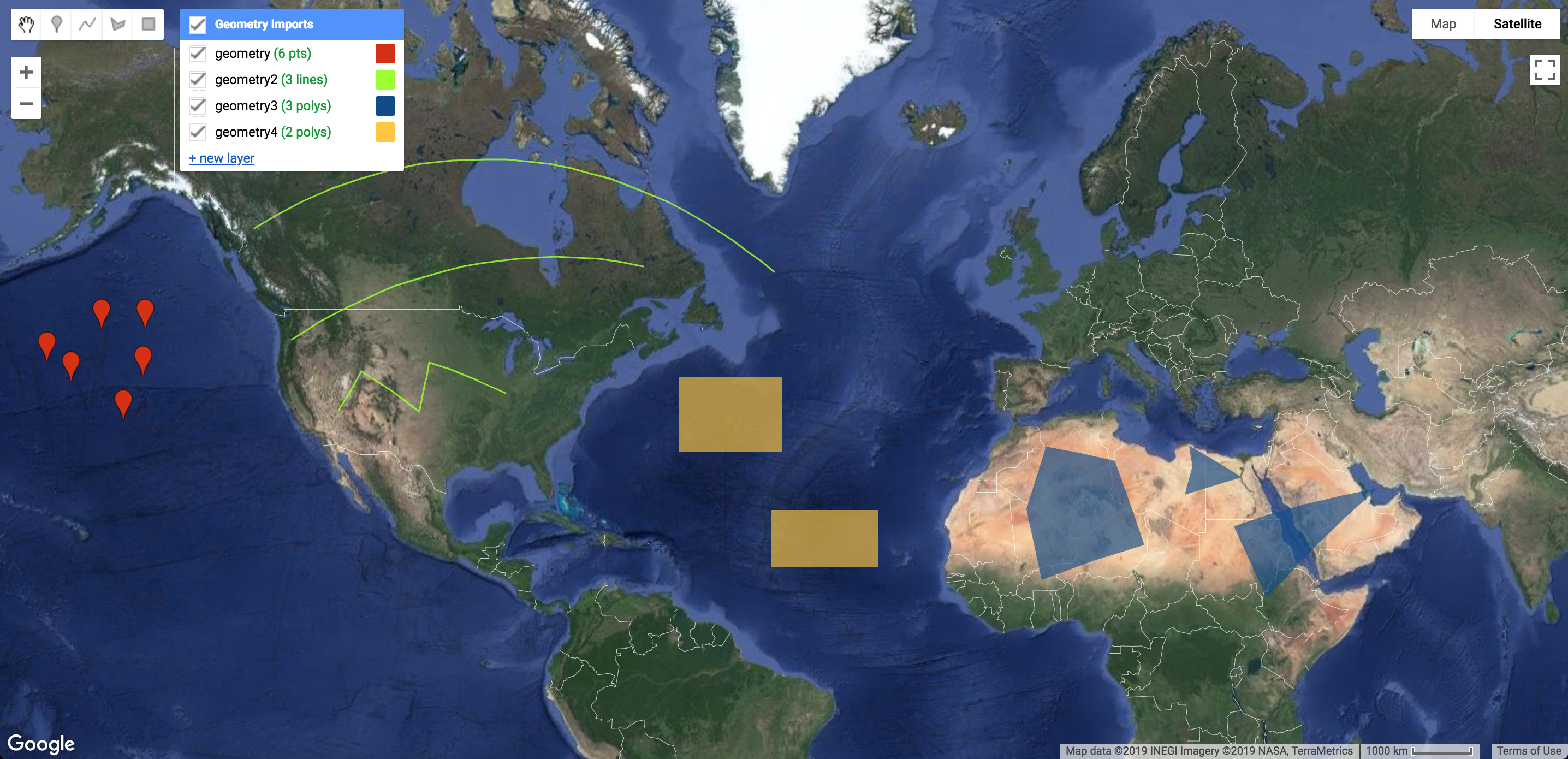
You can also import geometries to your script by drawing them on screen. To create geometries, use the geometry cartoon tools in the upper left corner of the map display (Figure 8). For drawing points, apply the placemark icon  , for drawing lines, employ the line icon
  , for drawing polygons, use the polygon icon
  , for cartoon rectangles use the rectangle icon
  . (Note that rectangles are planar geometries, so they cannot be placed on a layer with geodesic geometries like lines and polygons.)
Using any of the drawing tools will automatically create a new geometry layer and add an import for that layer to the Imports section. To add geometries to a new layer, hover on the Geometry Imports in the map brandish and click the +new layer link. You tin can also toggle visibility of the geometries from the Geometry Imports section. Note that drawn geometries are geodesic past default, except for rectangles, which are planar just. Employ the Geometry constructor to convert them to planar geometries. Learn more most geometries in Earth Engine on the Geometry page.
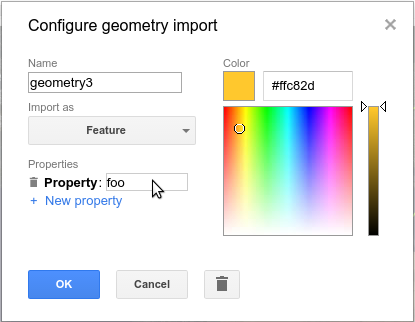
To configure the way geometries are imported to your script, click the icon next to the layer in the Geometry Imports section on the map or in the Imports section of the code editor. The geometry layer settings tool will exist displayed in a dialog box which should expect something like Figure 9. Note that you tin import the drawn shapes as geometries, features or characteristic collections. The geometry import settings also allow you to change the colour with which the layer is displayed, add properties to the layer (if it is imported as a Characteristic or FeatureCollection) or rename the layer.
Finally, to prevent geometries in a layer from being edited, y'all can lock the layer past pressing the icon next to the layer. This will prevent adding, deleting, or editing any geometries on the layer. To unlock the layer once again, press the icon.
Help!
Click the push button in the upper right of the Code Editor to see links to this Developer's Guide, other help forums, a guided tour of the Code Editor and a list of keyboard shortcuts that help with coding, running code, and displaying information on the Map. Click the button to file a bug report, asking a new feature, advise a dataset, or otherwise transport feedback when no response is needed.
Source: https://developers.google.com/earth-engine/guides/playground
0 Response to "Output Message When You Click a Button Delete When Pressed Again"
Post a Comment