Sergeants Double Duty Flea & Tick Collar for Cats Reviews
By Michael D. Hull
Gray skies hung low and a steady drizzle dripped through the tall, dumbo fir trees near the High german-Belgian border on the morning of Thursday, November 16, 1944, during the Boxing of Hürtgen Woods.
As artillery volleys thumped occasionally in the distance, modest groups of chilled soldiers ventured out from the forward foxholes and bunkers of German General Hans Schmidt's 275th Infantry Division, scouting for signs of an expected American attack. Only a mile abroad, men of the U.S. 22nd Infantry Regiment's rifle and weapons companies rolled upward their blankets and ate breakfast. It would be their last hot meal for eighteen days. Officers and sergeants made concluding-minute preparations for an set on.

The "Double Deucer" Regiment had landed at Utah Embankment with Maj. Gen. Raymond O. "Tubby" Barton'southward 4th Infantry (Ivy) Partition on June 6, 1944, and suffered heavy casualties in the Normandy campaign. But, seasoned and with high morale, information technology was rated one of the best infantry regiments in the U.Due south. Regular army. Captain William S. Boice, 1 of its chaplains, called the 22nd Regiment "a fighting motorcar trained to an efficiency not matched at any fourth dimension during the war." Its motto was "Deeds, Not Words," and information technology would be awarded a Distinguished Unit Citation.
The regiment, virtually at total force, was allowable past 42-twelvemonth-one-time Colonel Charles T. Lanham, a wiry, graying 1924 graduate of West Indicate and former Infantry School instructor and War Section staffer. Also a poet and writer, his prewar work on infantry manuals had caught the attention of General George C. Marshall, and the Ground forces primary of staff listed Lanham in his "black book" of up-and-coming officers. The scrappy Lanham led from the front to the point of foolhardiness and expected his inferior officers to do the same. He told them, "Every bit officers, I expect y'all to atomic number 82 your men. Men will follow a leader, and I expect my platoon leaders to be right up front. Losses could be very high. Utilise every skill you possess. If you lot survive your first boxing, I'll promote y'all. Good luck."
Cadet Lanham's Men Along the Three-Mile Front
Moody and prone to depression, Lanham was described by some soldiers as brilliant but "crazy equally hell," while one officer said he wanted to win the war all by himself. But there was never any question of his courage.
Stretched thinly, "Cadet" Lanham's regiment was responsible for a three-mile forepart in the twenty-mile-by-ten-mile Hürtgen Wood, situated in a 50-square-mile triangle divisional past the German cities of Aachen and Duren and the town of Monschau. At that place, a prolonged and biting battle of attrition was being waged by American and German soldiers, and nowhere else on the front end lines during World War 2 was the stamina, courage, and fighting spirit of U.Due south. soldiers tested more than severely.
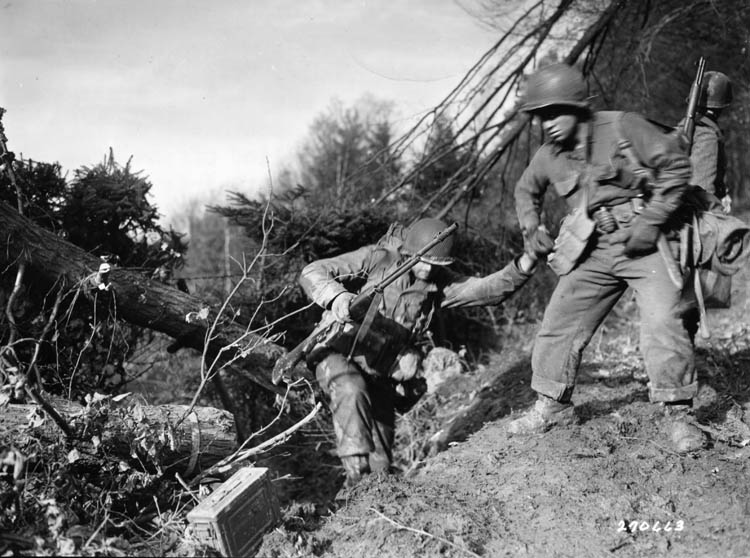
When all was prepare on November 16, soldiers of the 22nd Infantry Regiment's forward companies waded beyond the Roter Weh stream and began climbing a fir-clad ridge toward the Roer River plain, five miles ahead. They were starting 18 days of hell in the Hürtgen Forest "meat-grinder." Famed novelist Ernest Hemingway, a friend of Colonel Lanham and a correspondent for Collier's magazine, described the Boxing of Hürtgen Forest as "Passchendaele with tree bursts." He was recalling the grim Western Front battle of 1917 in which British and Canadian troops suffered 300,000 casualties in gaining a v-mile-deep salient.
Like many other units engaged, the Double Deucers fought longer than commonly expected in the gloomy Hürtgenwald, and few American gainsay outfits have ever experienced such severe casualties. Afterwards iii days, the regiment had lost its iii battalion commanders, and the compunction rate among rifle company leaders was more 300 percentage. Past the stop of the 6th solar day, the regiment had suffered 50 percent casualties, the point at which an infantry unit is considered to have lost much of its effectiveness. Past the night of Nov 20, after five days in action, the 22nd Regiment's burglarize companies had lost more 40 percent of their force. And then, Colonel Lanham's men fought for some other 12 days.
Despite heavy artillery support, it cost the regiment 2,806 casualties to accelerate half-dozen,000 yards—averaging just over 300 yards a 24-hour interval—during eighteen continuous days of activity. I soldier savage for every two yards gained. The regiment'south prey rate was a staggering 86 percent of its normal strength of 3,250 officers and men. And it was not alone, for several divisions and regiments were mauled in the campaign. General J. Lawton Collins, dashing commander of the U.South. Seven Corps, a veteran of Guadalcanal and liberator of Cherbourg, called Hürtgen a "green hell," while Maj. Gen. James M. Gavin, the youthful, gallant commander of the 82nd Airborne Division, characterized the forest as an "water ice-coated moloch with an insatiable appetite."
Lasting from September 1944 to Jan 1945, the campaign was part of a bulldoze by the U.Due south. First Army, led by white-haired, dependable Lt. Gen. Courtney H. Hodges, to cross the Roer River and somewhen capture its vital dams. The overall aim was an attack on the Aachen-Cologne centrality designed to close with the River Rhine, every bit a starting time pace toward the envelopment of the industrial Ruhr Valley. The fighting was bitter considering the two woods dams controlled the water level of the Roer River flowing due north. The Allies could not launch a broad, massive attack across the Cologne Obviously to the Rhine as long as the enemy held the dams and could threaten to alluvion the Roer River Valley.
The Roer and the Aachen Bars the Way into Germany
By September 1944, the British, American, and Canadian Armies were crowding against the borders of Federal republic of germany. Afterward the unexpected success of the Normandy breakout, the Centrolineal high command believed that the enemy was virtually defeated. Euphoria overcast audio strategic judgment, and some rude awakenings lay ahead. The German Regular army was being pushed dorsum to its dwelling house ground, merely it was still a well-disciplined and formidable force. Its defenses—both natural and man-made—were strong, and it was resisting the Centrolineal cause more stubbornly than always.
The rugged Vosges Mountains in northeastern France formed a traditional defensive barrier, while the Siegfried Line and the Rhine River comprised a significant obstacle to the Allied forces. The weather worsened that autumn and winter, and a series of bitterly contested battles—Walcheren Isle, Aachen, the Saar Basin, the Vosges Mountains, the Reichswald Forest, and the Hürtgen Forest and the Roer River—was fought under the most trying conditions. Besides the weather, the Centrolineal armies were plagued by shortages of ammunition and supplies.
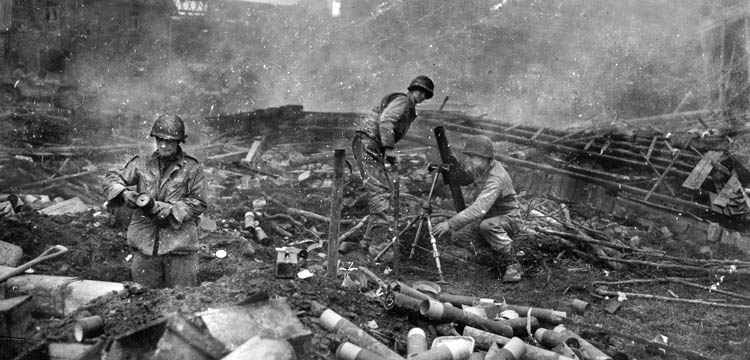
The Allied loftier command was eager to breach the German language edge defense lines, vault beyond the Rhine, and button into the Reich, only the mode was barred by the River Roer and the large forested area southward of Aachen. The corridor for accelerate was narrow and unsuitable for big-calibration maneuvering. Nevertheless, Generals Collins and Hodges decided that it was necessary to clear the Hürtgen Woods. The one-time said later, "If we would have turned loose of the Hürtgen and allow the Germans roam there, they could accept hitting my flank."
In their haste to enter Germany, the Americans underestimated this major obstacle on the path to the Roer River, the strongly defended woods with its dense trees, deep ravines, and lack of roads. Collins and Hodges fabricated no plans to capture the hydroelectric and overflowing-control dams on the river, just inside the forest. It would exist too perilous to ship troops across the Roer while the enemy controlled the dams. They were the key to the river, merely it would take a biting struggle in the forest past several divisions before Hodges ordered an attack against them.
The first engagements during the Battle of Hürtgen Woods were fought by Brig. Gen. Maurice Rose'southward tertiary Armored Division in September 1944. It was followed past the ninth Infantry Division, the 28th Infantry (Keystone) Division, and numerous supporting units equally the Americans hammered with little success against the German pillboxes and bunkers deep in the damp, gloomy forest. Reinforcing combat groups were fed piecemeal into the Hürtgen cauldron. The other units involved in the grueling campaign were the 1st, eighth, ninth, 78th, and 83rd Infantry Divisions, the 5th Armored Division, the 505th and 517th Parachute Infantry Regiments, and the 2nd Ranger Battalion, led past Lt. Col. James Eastward. Rudder of Pointe-du-Hoc fame.
A series of attacks in the forest were ill fated, and from the first the campaign reflected little credit on the senior American commanders. The initial objective, to protect General Collins' flank, was express, and the high command failed to recognize that the Roer River dams would allow the enemy to flood any Allied advances fabricated to the n. The Hürtgenwald was valuable territory to the Germans, and its loss would threaten their unabridged defense line west of the Rhine.
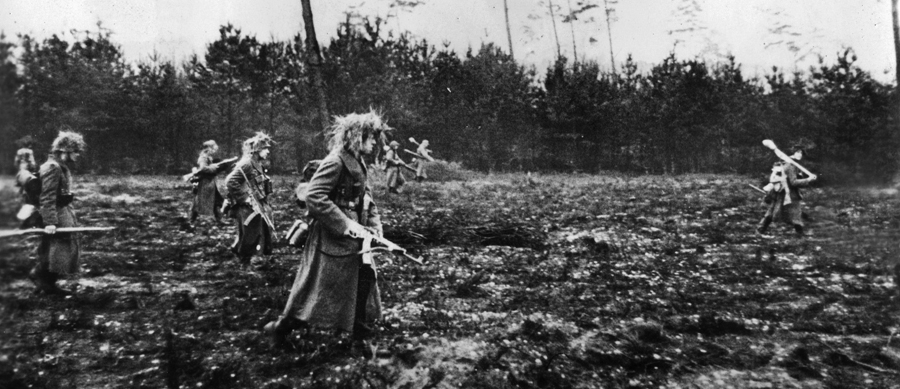
The American high control blundered by not proposing an easier avenue of approach southeast of the Hürtgen Forest, allowing Hodges' regular army to seize the dams and and so clear the difficult terrain downriver. The offensive as undertaken placed the American forces at a severe disadvantage in the forest. In that location, the Germans were able to delay and wear downward the Americans, providing security and buying critical fourth dimension to fix for the Ardennes counteroffensive.
The Battle of Hürtgen Forest: A Campaign that Could (and Should) Have Been Avoided
In the Hürtgenwald, the U.Southward. Showtime Army encountered a tactical nightmare. Starting on October 6, two attacking regiments had to fight for five days to advance ane mile to the first clearing in the forest. The ninth Infantry Division so took 10 days of intense combat to push another mile. The ii-mile advance cost almost 5,000 casualties. More divisions, including Maj. Gen. Norman "Dutch" Cota's long-suffering 28th Infantry Sectionalisation, were fed into the Hürtgenwald maelstrom, and the losses continued to mount.
The truculent Hodges did not press for air attacks on the Roer River dams until late November, merely they failed. Direct hits were fabricated, merely the concrete structures were then massive that damage was negligible. On December thirteen, three months after the showtime GIs entered the Hürtgen Wood, a ground assail on the dams was launched. It would not be until February 1945 that Hodges had control of the dams and was able to confidently place troops on the eastern bank of the Roer River.
One reason for the intensity of the struggle in the forest was that the intention of General Omar Northward. Bradley's U.S. 21st Army Group to reach for the strategic city of Aachen had been obvious to the enemy for some time. In the Hürtgenwald, solidly dug in with 1,000 well-curtained guns and enough of ammunition, were the men of Full general Erich Brandenberger'south German Seventh Regular army, General Gustav von Zangen's 15th Army, and General Hasso von Manteuffel's Fifth Panzer Ground forces.
The Boxing of Hürtgen Forest was a entrada that could and should have been avoided—a campaign of prolonged and bitter attrition in which U.S. infantrymen were challenged by stubborn, unyielding defenders, rugged terrain, and appalling atmospheric condition. Army Colonel David H. Hackworth, a distinguished battalion commander in the Vietnam War, chosen the Hürtgen boxing "i of the most costly blunders of World War II."
The Hürtgen campaign was strictly a foot soldier's war because the thick, ravine-creased woods, steep ridges, lack of a route net, mud, and weather conditions—rain, fog, sleet, and snowfall—negated the customary American superiority in armor and air ability. It was only late in the battle that U.S. tanks were able to exist deployed, and it was left to the infantry to decide the boxing. In the final measure out, it was sheer guts rather than skill that got them through the woods. In the terminate, the campaign absorbed some 17 divisions, caused dreadful casualties, and proved a heavy strain on troop morale. It was one of the worst reverses for the U.S. Ground forces in the European Theater.
American soldiers faced no greater odds nether such harrowing conditions in Earth War Ii than did the riflemen, machine gunners, and mortarmen who struggled through the Hürtgenwald. "The woods upwardly there was a hell of an eerie place to fight," reported Technical Sergeant George Morgan, an armorer-artificer of the 1st Battalion, 22nd Infantry Regiment. "Prove me a human who went through the boxing and who says he never had a feeling of fear, and I'll show you a liar. You lot can't get all of the expressionless considering you tin can't find them, and they stay there to remind the guys advancing as to what might hit them. You can't get protection. You lot can't meet. You can't get fields of fire. Arms slashes the trees similar a scythe. Everything is tangled. You can scarcely walk. Everybody is common cold and wet, and the mixture of cold pelting and sleet keeps falling. So they leap off again, and before long there is only a handful of the old men left."
Colonel Lanham observed wryly, "Upward there, information technology was our troops who combed the tree bursts out of their pilus while the Kraut lay snug in his hole."
Because it was so disastrous, and considering Americans tend to remember merely victories, the Battle of the Hürtgen Forest has been well-nigh forgotten. Overshadowed by Operation Market Garden, the Allied invasion of Kingdom of the netherlands in September 1944, and the momentous Ardennes campaign of December 1944 and January 1945, the tragic Battle of Hürtgen Forest was accorded but brief mention in the memoirs of such generals equally Dwight D. Eisenhower and Omar N. Bradley and has been overlooked by nigh historians.
A Great Sacrifice for a Few Miles of Frozen Rubble and Swampland
When the battle finally fizzled out, all the Americans had to show for their sacrifices were a few miles of tree stumps, shell holes, shattered buildings, and swamps. British troops played a minor office in the campaign, merely they were able to proceeds new respect for the fighting spirit and fortitude of their allies. The Battle of Hürtgen Forest echoed the horrors of the World War I killing grounds and brought much suffering to the enemy soldiers besides as the GIs. A German officer reported, "Bully losses were caused past numerous frost bites. In some cases, soldiers were found dead in their foxholes from sheer exhaustion."

The village of Hürtgen changed hands 14 times during the battle, and the village of Vossenack viii times. In at least one U.Due south. infantry battalion, morale cracked under the strain. In four days' time, three visitor commanders lost their commands. In one rifle visitor, all of the officers were relieved or broke under the strain, while a platoon commander who refused to club his men into the line was put under abort. Soldiers of all ranks bankrupt downward under the strain of continuous combat.
The Hürtgen campaign mirrored the best and the worst in the American foot soldier. Several men were awarded the Medal of Accolade and the Distinguished Service Cross, and in that location were many other acts of gallantry that never came to calorie-free. Just there were also instances in which fearfulness paralyzed men who had seen more gainsay than they could stomach. Some GIs ran from their positions when the enemy was non virtually; others refused to movement without armored back up, and some tank crews would not go forward without infantry protection.
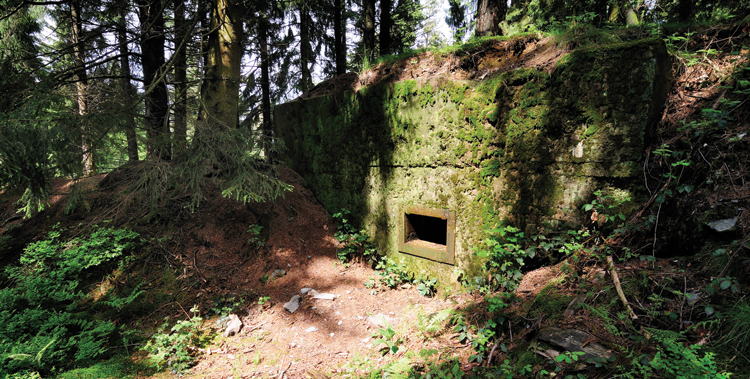
Shells bursting in the tops of the 100-pes fir trees and mines planted in the wood flooring made life particularly hellish for the American infantrymen in the Hürtgen Forest. A tree burst would send steel fragments and timber raining down, and foxholes provided scant protection. Many GIs fell victim to their own arms. The enemy troops also suffered severely from the beat bursts in the trees. General Schmidt, commander of the High german 275th Infantry Division, reported, "The weird and wild surroundings intensified all combat reactions and impressions, particularly since the effect of the shells exploding in the treetops was much greater due to the falling and splintering of trees and branches. Small arms burn hit trees and branches with a sharp scissure, and the enemy often appeared suddenly close at hand and engaged in embittered shut combat."
Mine fields in the forest were an additional peril, and keeping safe paths through them proved difficult. Engineers marked cleared paths with white record, simply this was invariably diddled away by the wind or obscured past snow and mud.
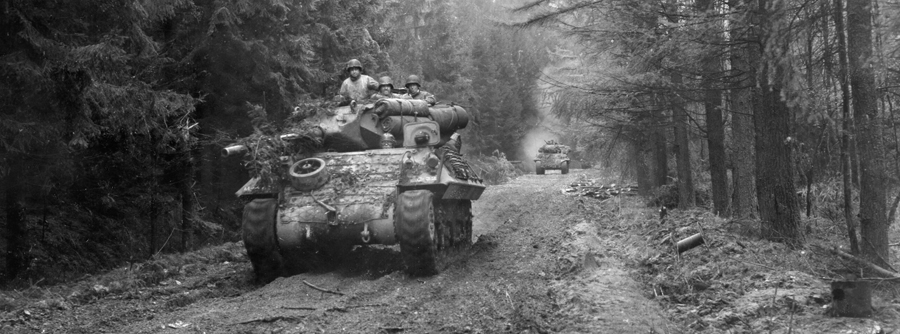
When U.S. armor was eventually brought up to back up the infantry, mines and the dense trees forced the tanks to stick mainly to the few narrow, muddy wood roads and logging trails, preventing them from maneuvering. The roads were also mined, and a disabled tank or truck could block a whole column.
The Elements Were Just equally Fearsome a Foe
Besides the enemy and the weather, the GIs battled burnout, hunger, boxing fatigue, pneumonia, and trench foot. They lacked sufficient boots and winter wear, and hot meals and a dry out identify in which to sleep were almost nonexistent. The men in the forward companies spent long nights, one-half frozen in open foxholes with just their uniforms for protection. Much to the surprise of British troops in the area, the GIs were forced to subsist on cold C-rations. Many went without hot food for days on end.
Ane British Regular army officer reported, "What surprised us was the apparent indifference of the American commanders to the physical needs of their men in winter warfare. In these atmospheric condition, hot food once a day is every bit vital as armament. In the first few days, the infantry of the 84th Sectionalisation were expected to exist on packets of odd items such as eggs and bacon compressed into tablets, gum and candy, with nothing hot to drink. Men fight with greater cheerfulness even on the cheapest form of pig's abdomen of transatlantic origin masquerading as bacon, if hot, or the bully beef and tea and biscuits which maintained the British. They also need a pair of dry socks every solar day."
The 84th Division suffered 500 casualties from trench foot.
Before the Battle of Hürtgen Forest and the campaigns of the wintertime of 1944-1945, no American soldiers had suffered such hardships equally did the men in that nightmarish forest. Overcoats soaked with wet and caked with frozen mud became too heavy to wearable. Rain seeped into radios and rendered them useless, and the forest floor was so tangled with castor and debris that men bankrupt under the physical strain of conveying weapons, moving supplies forrard, and evacuating the wounded.
The fighting was often at such shut quarters that hand grenades were the only decisive weapons. Booby traps in abased foxholes and ditches turned promised sanctuaries into graves for the unwary. The Germans sometimes planted explosives underneath wounded men; ane GI lay motionless for 72 hours, struggling to remain conscious so that he could warn whoever might come to his rescue. Meanwhile, as the living strove to survive, the bloated, frozen bodies of the dead lay strewn in grotesque positions.
"The toll was staggering," reported i American survivor of the Hürtgenwald campaign. "Past mid-Dec, the three line companies of my armored infantry battalion had left only 4 officers and 170 enlisted men; at full strength, its complement was 18 officers and 735 enlisted men. Commanders of the three line companies had been either killed or wounded."
The slaughter and misery dragged on well into December 1944, when the Americans were ordered to pull out of the forest. Some did non withdraw until Christmas Eve. By that time, all attending from the Allied high command on down was stock-still upon the debacle caused past Field Align Gerd von Rundstedt'due south corking breakthrough in the Ardennes on December 16.
Full general Bradley's Major Blunder
At least 120,000 U.S. troops took role in the Battle of Hürtgen Forest, and an estimated 24,000 were killed, wounded, or captured. Combat fatigue, pneumonia, and trench pes claimed another nine,000 men.
When the appalling losses were revealed, some participants and high-ranking officers, both American and German language, questioned the necessity of the campaign and regarded it as a major corrigendum on the role of General Bradley. Blame for the initial reverses, panic, and confusion in the Battle of the Bulge had also been laid at his door. The critics questioned Bradley's wisdom in choosing to brand his main try through the Hürtgenwald instead of using the more open, easier going further north on the Ninth Army forepart betwixt the U.S. First and British Second Armies. The hapless Bradley responded cryptically, "You don't make your main effort with your exterior forcefulness."
Lieutenant Frank Fifty. Gunn, commander of the 2nd Battalion, 39th Infantry Regiment, which captured the village of Merode, said, "In hindsight, it seemed to me that the Hürtgen Forest could accept been contained rather than assaulted, and a big flanking or encircling movement performed past corps. This would accept reduced the casualties and even so accept achieved the mission of capturing the dams on the Roer River."
Lieutenant William Burke, a company commander in the 803rd Tank Destroyer Battalion, agreed: "Some of u.s. with combat feel from the beaches to Hürtgen were hard pressed to empathize the tactical wisdom of slogging it out in such an unforgiving surroundings instead of bypassing it."
Major General Rudolph Gersdorff, chief of staff of the German 7th Regular army, was quoted every bit maxim, "The German command could not sympathise the reason for the stiff American attacks in the Hürtgen Forest.… The fighting in the wooded area denied the American troops the advantages offered them by their air and armored forces, the superiority of which had been decisive in all the battles waged before."
Ironically, some experts saw the disastrous Battle of Hürtgen Forest as having unintended consequences beneficial to the American crusade. The bloodletting, particularly the fight effectually the villages of Hürtgen, Kleinhau, and Grosshau, may have altered the outcome of the Battle of the Burl by presenting a strong shoulder that the German 6th Panzer Army never broke. If the U.Southward. effort had bypassed the Hürtgenwald to the north in November 1944, it was reasoned, the woods could have served both as a hinge on which the German counteroffensive would pivot in December and as a natural shield to benefit the enemy.
Ill conceived in the Centrolineal loftier command's haste to reach the gates of Nazi Federal republic of germany, the Hürtgen Wood campaign was a strategic blunder that could have been avoided—a 5-month waste of American lives and resources.
However, despite the many hardships and appalling losses, the U.South. infantry there were able somehow to maintain unit integrity and to persevere. While criticism vicious inevitably upon the high command, there was no questioning the heroism and determination of the GIs in the foxholes.
The historian of the fissure British Guards Armored Partitioning, which exchanged officers and men with the Americans, reported, "Their [the Americans'] methods might be somewhat curious and unorthodox, but at that place could be no doubtfulness about the excellent results when put into practice. Divisions such every bit the 29th and 30th Infantry which fought in this battle could accept challenged comparison with the finest of our own."
Echoes of the Great War
The plush Boxing of Hürtgen Forest seriously weakened Hodges' First Army, with its extended front line unable to resist the German onslaught in the early hours of the Battle of the Burl. The Big Red One and ninth Infantry Divisions had to depend nigh entirely on replacements after Hürtgen, and the 4th and 8th Infantry Divisions also had big manpower gaps to fill. The 2d Ranger Battalion and the 517th Parachute Infantry Regiment emerged from the bloody forest as skeletal units. General Cota's 28th Partitioning was trying to recover and regroup in the town of Wiltz in northern Grand duchy of luxembourg when it was struck past von Rundstedt's accelerate columns on December 16.
The Boxing of Hürtgen Forest was replayed a few weeks afterward, presently earlier the end of the European state of war, in the Battle of the Reichswald equally Field Marshal Bernard Fifty. Montgomery'south British 21st Army Grouping closed to the River Rhine. There, in a big tract of gloomy wood southwest of Cleves in Westphalia, troops of the 2nd Canadian Division and v British Regular army divisions had to battle through five German language defense lines on a narrow, flooded front. Function of Monty's Performance Veritable, the offensive in the Reichswald—the northern ballast of the Siegfried Line—kicked off on February 8, 1945, and involved vehement fighting in heavy rains. Despite support by arms and Regal Air Force bombers, progress was deadening and the casualties heavy. The forest was not cleared until March nine.
Like the Hürtgen campaign, the Reichswald struggle bore marked similarities to the grim fighting on the Western Forepart in 1914-1918 and has been overlooked past most historians.
Author Michael D. Hull was a frequent contributor to WWII History. He resided in Enfield, Connecticut.
Source: https://warfarehistorynetwork.com/2020/01/29/the-battle-of-hurtgen-forest-a-tactical-nightmare-for-allied-forces/
0 Response to "Sergeants Double Duty Flea & Tick Collar for Cats Reviews"
Post a Comment